GMLAN
The GMLAN page of a connection speaks GMLAN (GMW3110), the diagnostic protocol of GM, Opel and Vauxhall vehicles. It is the GM counterpart of the Diagnostics (UDS) page: GMLAN runs over normal CAN frames with a transport (USDT) that works like ISO-TP, but the service layer is GM-specific — one-byte data identifiers, services such as ReturnToNormalMode and ReadDiagnosticInformation, and the GM DTC format.
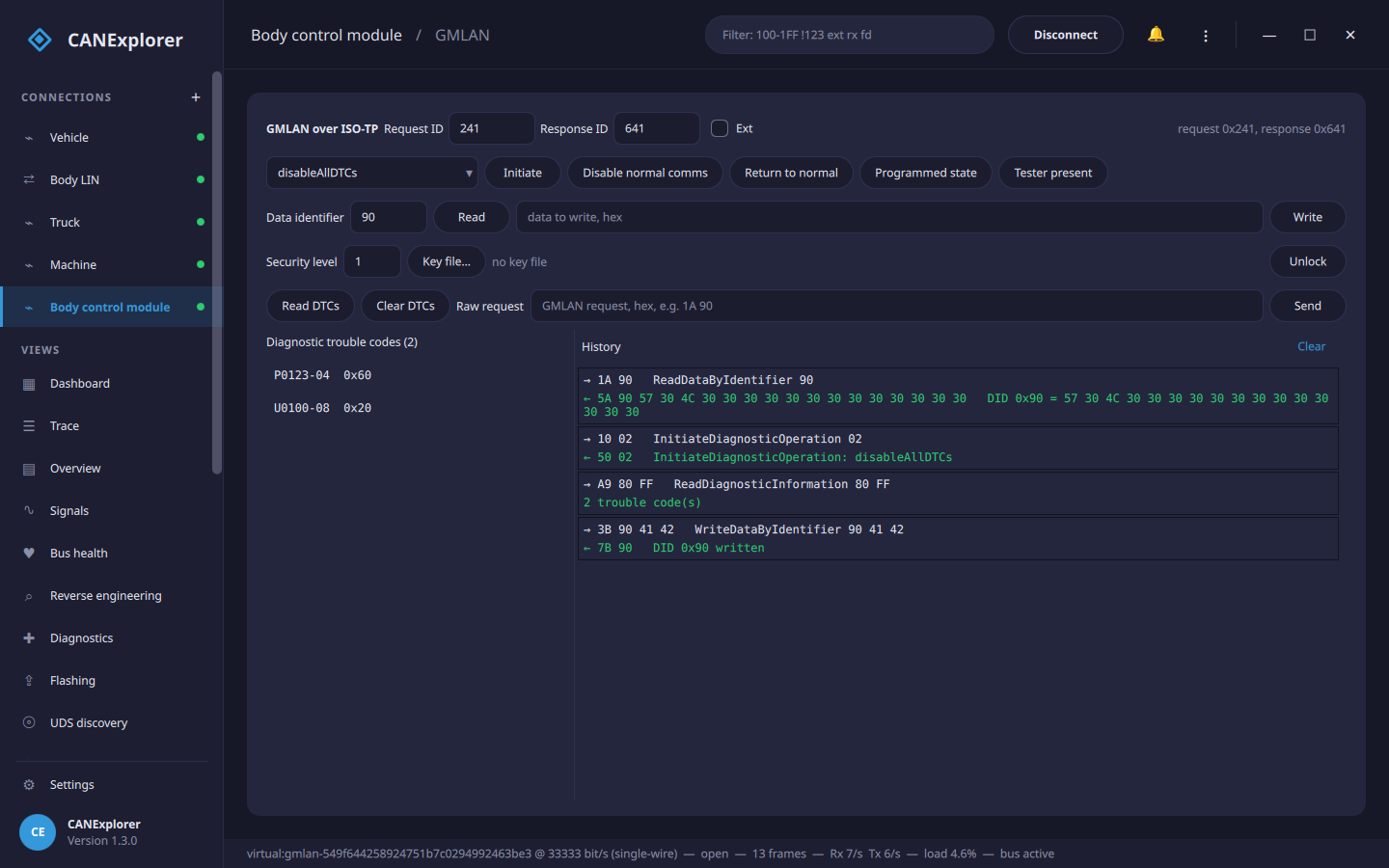
Open the connection to the vehicle's bus first, then go to the GMLAN page. It is available on any CAN connection that can send; it is most often used on a single-wire bus.
Single-wire CAN (SWCAN)
Many GM/Opel body and comfort modules are on GMLAN single-wire CAN — a one-wire bus at 33.3 kbit/s (with an 83.3 kbit/s high-speed mode for flashing). Tick Single-wire CAN (GMLAN) in the new-connection dialog to open such a bus; it sets the bitrate to 33333 and selects the single-wire transceiver on interfaces that have one (e.g. Kvaser). On SocketCAN the single-wire bitrate is set on the link; the virtual interface carries the same frames, so a single-wire setup can be tried without hardware.
The frames themselves are ordinary CAN frames, so the whole of CANExplorer — the trace, reverse engineering, signal plots — works on a single-wire bus as on any other.
Addressing
GMLAN diagnostics use 11-bit CAN identifiers. Set the Request ID the tester sends on and the Response ID the ECU answers on (physical responses are commonly the request id plus 0x400; functional requests to all nodes go on 0x101). Ext uses 29-bit identifiers.
Services
| Button | GMLAN service |
|---|---|
| Initiate | InitiateDiagnosticOperation (0x10): disableAllDTCs, enableDTCsDuringDeviceControl, wakeUpLinks |
| Disable normal comms | DisableNormalCommunication (0x28): stop the ECU's normal application messages |
| Return to normal | ReturnToNormalMode (0x20) |
| Programmed state | ReportProgrammedState (0xA2) |
| Tester present | TesterPresent (0x3E), sent periodically to keep diagnostics alive |
| Read / Write | ReadDataByIdentifier (0x1A) / WriteDataByIdentifier (0x3B) — GMLAN identifiers are one byte, e.g. 0x90 for the VIN |
| Unlock | SecurityAccess (0x27): request a seed on an odd level, send the key from the key file |
| Read DTCs | ReadDiagnosticInformation (0xA9): the trouble codes, shown as P0123-04 (code and failure-type byte) with their status |
| Clear DTCs | ClearDiagnosticInformation (0x04) |
| Raw request | Any service as hex bytes, e.g. 1A 90; the response is decoded in the log |
Diagnostics change the running ECU
Disabling normal communication, security access, writing identifiers and device control change how the ECU behaves. Use them on vehicles you own or are authorised to work on, stationary, with a stable supply.
In scripts
can_explorer.core.gmlan drives GMLAN from test scripts, over the same transports as UDS
(IsoTpClient):
from can_explorer.core.gmlan import GmlanClient
from can_explorer.core.isotp_client import IsoTpClient

client = GmlanClient(IsoTpClient(session, 0x241, 0x641))
print(await client.read_data_by_identifier(0x90))  # VIN
for dtc in await client.read_dtcs():
    print(dtc.text, hex(dtc.status))
await client.clear_dtcs()
can_explorer.core.simulation.GmlanEcuSimulator is a simulated GMLAN ECU for trying the page and for test scripts.