SOME/IP
SOME/IP (Scalable service-Oriented MiddlewarE over IP) is the service-oriented middleware of automotive Ethernet. The SOME/IP tool listens on UDP, discovers the services offered on the network through SOME/IP-SD (Service Discovery) and shows the decoded messages.
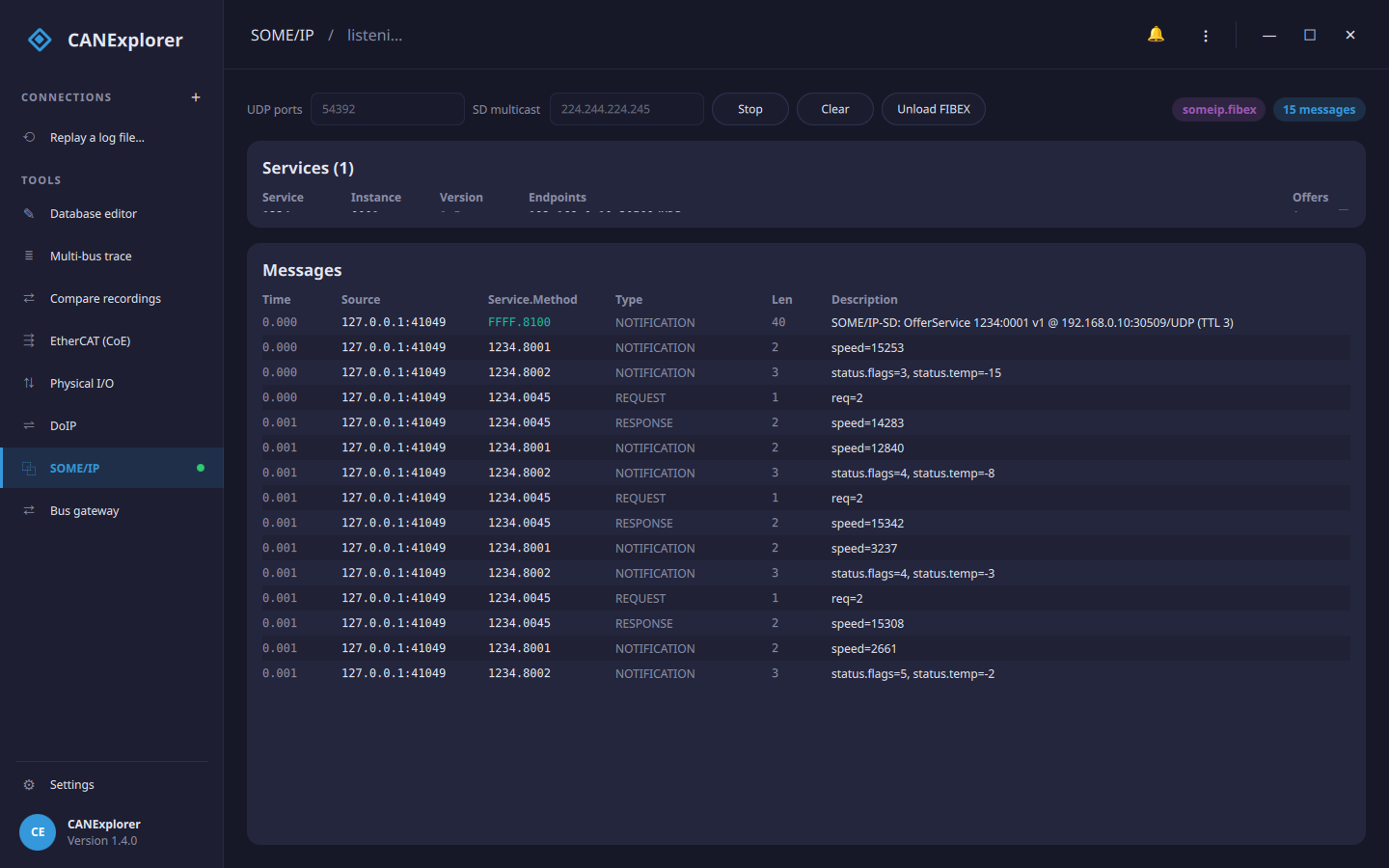
Listening
Enter the UDP ports to listen on (comma separated; 30490 is the usual Service Discovery port) and the
SD multicast group to join (the ASAM default is 224.244.224.245; leave it empty to listen on unicast only),
then Listen. Stop closes the sockets and Clear empties the tables.
What a socket sees
A plain UDP socket receives the multicast groups it joins and the traffic addressed to this host. To capture all SOME/IP on the wire — unicast between other ECUs — the computer needs to sit on a network tap or a switch mirror port; passive packet capture is not done by the tool itself.
Services
Every service announced with OfferService in Service Discovery is listed with its Service and Instance IDs, its Version (major.minor), the Endpoints it offers (address, port and transport), and how many offers have been seen. A service whose offer expires (TTL 0, StopOfferService) is removed.
Messages
Each SOME/IP message is shown with the time (relative to the first message), the Source (sender address and port), the Service.Method ID, the message Type, the payload length and a decoded Description:
- REQUEST, REQUEST_NO_RETURN, RESPONSE, ERROR (with the return code) and NOTIFICATION (events,
whose method id has the top bit set), and their segmented
_TPvariants. - SOME/IP-SD messages (service
FFFF, method8100) are expanded into their entries: OfferService, FindService, SubscribeEventgroup and the acknowledgements, with the service, version, endpoints and TTL.
Decoding payloads (FIBEX / ARXML)
Load a FIBEX or AUTOSAR ARXML file (FIBEX / ARXML…) describing the SOME/IP service interfaces to decode
the message payloads into named signals: the Description column then shows the decoded values (for example
speed=4000 or status.flags=3, status.temp=-15) instead of the payload length. A method's request and response
are decoded with their own parameters. The format is chosen by the file extension (.arxml for ARXML, otherwise
FIBEX).
A subset of each is read: service interfaces with their methods (input and return parameters) and events, and the
data types they use — scalars, fixed and dynamic arrays, length-prefixed and fixed strings, and nested structures.
From ARXML the SOME/IP service/method/event ids come from the SOMEIP-SERVICE-INTERFACE-DEPLOYMENT elements, which
reference the service interfaces. Unions, optional (TLV) members and bit fields are not read; a message whose type
uses one keeps its generic description.
The live SOME/IP tool reads UDP. SOME/IP carried over TCP (reassembled across segments) and SOME/IP-TP segmented messages are decoded when you open a capture in the Ethernet capture tool.
End-to-end protection (E2E)
AUTOSAR E2E protection (the CRC and sequence counter that guard a PDU against corruption, loss, repetition and
reordering) is available as a library for scripts — can_explorer.core.e2e provides the AUTOSAR CRC routines
(crc8, crc8h2f, crc16, crc32, crc32p4) and E2E Profile 2 protect/check. Validating a live PDU needs
its E2E configuration (profile, Data IDs, offset) from the ARXML, which the UI does not read yet.